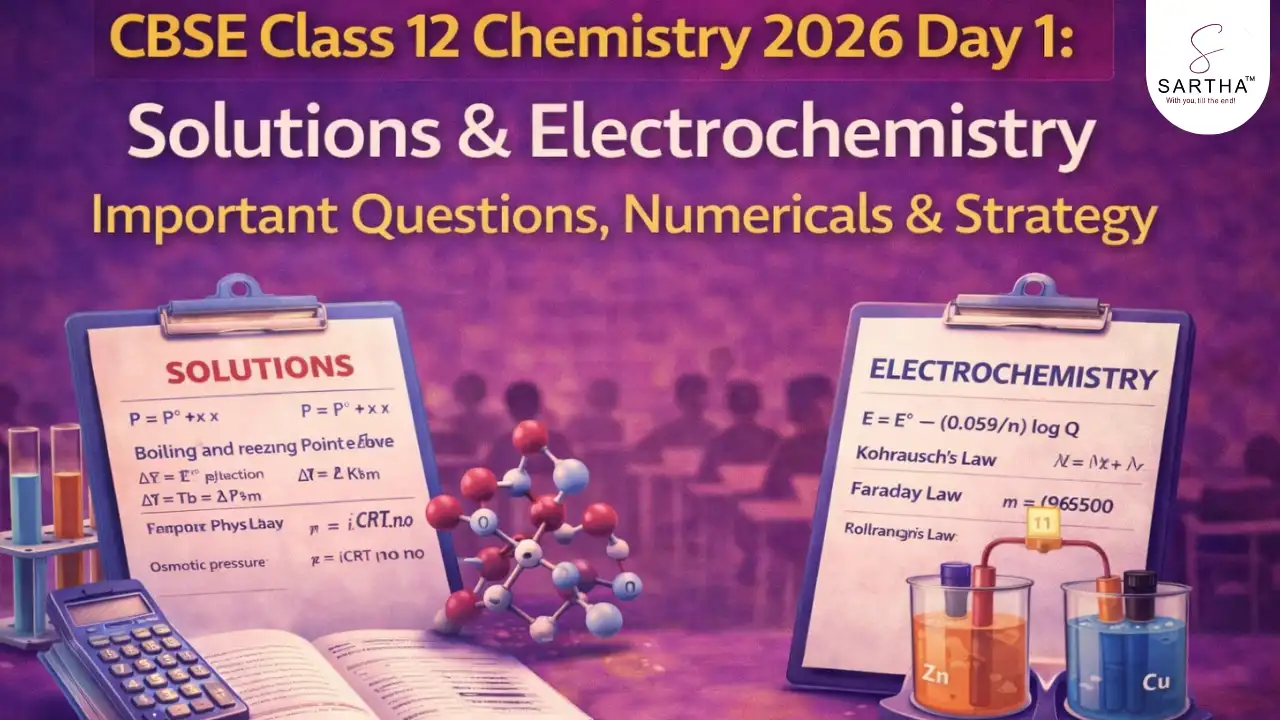
CBSE Class 12 Chemistry Paper 2026: Most Important Questions, Topics, Numericals & MCQs

CBSE Class 12 Chemistry Board Exam 2026 important questions and topics: check chapter-wise weightage, high-scoring chapters (Solutions, Electrochemistry, Chemical Kinetics, d- & f-Block, Coordination Compounds, Organic Chemistry), key numericals, named reactions, conversions, case-study MCQs and assertion-reason questions. Includes Nernst equation, half-life, Arrhenius equation, isomerism, amines, biomolecules and smart revision strategy to prepare for the CBSE 12th Chemistry exam.
CBSE Class 12 Chemistry Board Exam 2026 Important Questions, Topics
The CBSE Class 12 Chemistry Board Exam 2026 is scheduled on 28 February 2026. With only a few days remaining, this is not the time to study everything again — this is the time for smart revision.
This guide focuses only on high-weightage chapters, important questions, numericals and tricky MCQs that are repeatedly asked by CBSE. Nearly half of the question paper now consists of competency-based questions (MCQs, case-study and assertion-reason), so conceptual clarity is more important than memorization.
Chapter-Wise Weightage & Strategy
| Chapter | Marks | Why Important |
| Solutions | 7 | Direct numericals on colligative properties |
| Electrochemistry | 9 | Highest weightage + Nernst equation |
| Chemical Kinetics | 7 | Half-life and Arrhenius numericals |
| d & f Block Elements | 7 | Trends, oxidation states, lanthanoid contraction |
| Coordination Compounds | 7 | Nomenclature, hybridization and isomerism |
| Haloalkanes & Haloarenes | 6 | SN1/SN2 mechanisms |
| Alcohols, Phenols & Ethers | 6 | Distinguishing tests |
| Aldehydes, Ketones & Carboxylic Acids | 8 | Name reactions and conversions |
| Amines | 6 | Diazotisation and basicity order |
| Biomolecules | 7 | Structures and diagrams |
Join Channels For PDF & Updates
Get 2026 Board Exam PDFs, Important Questions, and News Updates for Class 12th.
 JOIN WHATSAPP CHANNEL
 JOIN TELEGRAM CHANNEL
Important: Organic chemistry conversions alone can contribute nearly 10–15 marks. Prepare reaction flowcharts linking haloalkanes → alcohols → aldehydes → acids → amines.
Important Short Answer Questions (2–3 Marks)
- 1. Differentiate between ideal and non-ideal solutions. Explain positive deviation.
- 2. Derive the Nernst equation and state its application.
- 3. Define order of reaction. Compare zero-order and first-order reactions.
- 4. Explain preparation of potassium permanganate from pyrolusite.
- 5. Show geometrical isomers of [Co(NH₃)₄Cl₂]+.
- 6. Explain nucleophilic substitution in chlorobenzene.
- 7. Distinguish phenol and ethanol chemically.
- 8. Explain Wolff-Kishner reduction.
- 9. Compare basic strength of amines.
- 10. Define nucleotides and describe DNA structure.
Important Long Answer Questions (5 Marks)
- 1. Derive elevation in boiling point and explain molecular mass determination.
- 2. Explain galvanic cell working and calculate EMF for Zn|Zn²⁺||Cu²⁺|Cu.
- 3. Derive half-life for first-order reaction.
- 4. Explain colour of transition metal compounds using crystal field theory.
- 5. Describe preparation and reactions of ethanal.
Important Numericals
- 1. Molality calculation of glucose solution
- 2. EMF calculation of hydrogen concentration cell
- 3. First-order rate constant time calculation
- 2026 Board Updates
2026 Board Papers PDF
Download Papers PDF , Important Questions & Get Updates for 2026 Board Exams.
High Probability Questions
1. Negative deviation from Raoult’s law occurs in:
a) Ethanol + Water
b) Acetone + Chloroform
c) Benzene + Toluene
d) Phenol + Aniline
Answer: b) Acetone + Chloroform
2. EMF of cell positive when:
a) Oxidation at anode
b) Reduction potential cathode > anode
c) Both
d) None
Answer: c) Both
3. Zero-order reaction graph:
Answer: Straight line decrease of concentration vs time
4. Lanthanoids show +3 state due to stable f-orbitals.
5. [Co(en)₃]³⁺ shows optical isomerism.
6. Finkelstein reaction converts alkyl chloride to iodide.
7. Phenol is more acidic than alcohol due to resonance stabilization.
8. Sucrose is non-reducing sugar.
9. Gas phase basicity: 3° > 2° > 1° > NH₃.
10. Electrolysis deposition ∝ quantity of electricity.