CBSE Class 12 Chemistry 2026 Day 1: Solutions & Electrochemistry Important Questions, Numericals & Strategy

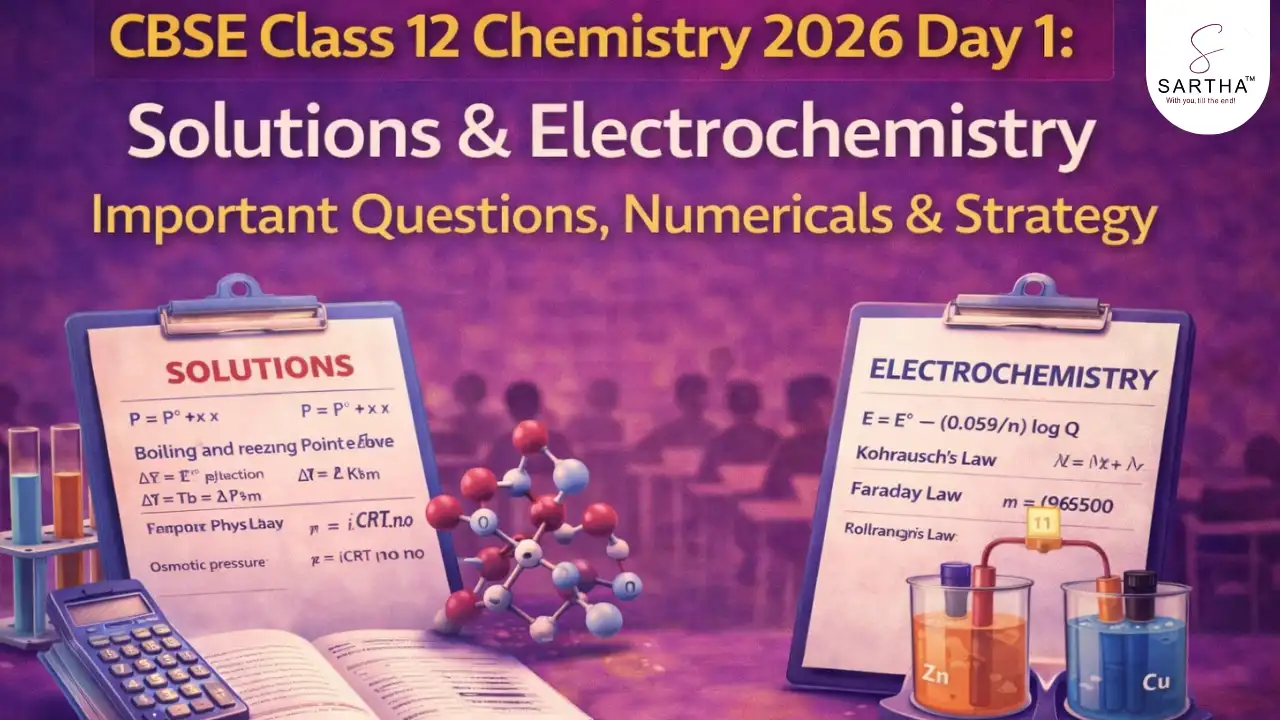
CBSE Class 12 Chemistry 2026 Day 1 revision plan Solutions and Electrochemistry important questions, high-scoring numericals and Nernst equation concepts for the 28 February board exam. Includes chapter-wise weightage, Raoult’s law, colligative properties, conductivity, Faraday law, common mistakes and smart attempt strategy to secure quick marks in Physical Chemistry.
With the CBSE Class 12 Chemistry board exam approaching, students should begin revision with the most scoring Physical Chemistry chapters — Solutions and Electrochemistry. Together these units contribute around 15–16 marks and mostly contain formula-based numericals. A clear understanding of formulas, units and the Nernst equation can help candidates secure quick marks and build confidence before attempting the rest of the paper.
Day 1 : Solutions (7 Marks) + Electrochemistry (9 Marks) – CBSE Class 12 Chemistry 2026 Important Questions, Numericals & Strategy
CBSE Class 12 Chemistry Board Exam 2026 is scheduled on 28 February 2026. To start your last-week preparation effectively, begin with the most scoring physical chemistry units — Solutions and Electrochemistry. Together these chapters contribute nearly 16 marks in the final paper and usually contain direct formula-based numericals.
These topics are not memory-based; they are logic and formula based. If formulas, units and substitutions are correct, you can easily score full marks. Most students lose marks only because of sign mistakes, unit conversion errors or wrong use of the Nernst equation.
Weightage & What CBSE Usually Asks
| Chapter | Expected Marks | Type of Questions |
| Solutions | 6–7 | Colligative numericals, Raoult’s law, abnormal molar mass |
| Electrochemistry | 8–9 | Nernst equation, conductivity, electrolysis, Faraday law |
| Total | 15–16 Marks | Mostly calculation based (high scoring) |
Join Channels For PDF & Updates
Get 2026 Board Exam PDFs, Important Questions, and News Updates for Class 12th.
 JOIN WHATSAPP CHANNEL
 JOIN TELEGRAM CHANNEL
Important Formula Quick-Revision Table
| Topic | Formula | What CBSE Usually Asks |
| Raoult’s Law | P = P° × x | Deviation from ideal behaviour |
| Boiling Point Elevation | ΔTb = i Kb m | Molar mass calculation |
| Freezing Point Depression | ΔTf = i Kf m | Degree of dissociation |
| Osmotic Pressure | π = i C R T | Polymer molar mass |
| Nernst Equation | E = E° − (0.059/n) log Q | Cell potential numericals |
| Kohlrausch Law | Λ° = λ°+ + λ°− | Weak electrolyte conductivity |
| Faraday Law | m = (Q × Eq.wt)/96500 | Electrolysis current problems |
Solutions – Quick Revision Points
- 1. Colligative properties depend only on number of solute particles.
- 2. Van’t Hoff factor: i > 1 → dissociation, i < 1 → association.
- 3. Positive deviation: weaker interactions (example: ethanol + water).
- 4. Negative deviation: stronger interactions (example: acetone + chloroform).
- 5. Azeotropes boil at constant composition.
Electrochemistry – Quick Revision Points
- 1. Anode = oxidation, Cathode = reduction.
- 2. Galvanic cell is spontaneous (Ecell positive).
- 3. At 298 K always use 0.059 in the Nernst equation.
- 4. Molar conductivity increases on dilution.
- 5. Corrosion is an electrochemical oxidation process.
- 2026 Board Updates
2026 Board Papers PDF
Download Papers PDF , Important Questions & Get Updates for 2026 Board Exams.
Most Important 1-Mark Questions
- 1. Define colligative property.
- 2. Write unit of conductivity.
- 3. Define electrode potential.
- 4. What is standard hydrogen electrode?
- 5. Define limiting molar conductivity.
- 6. What is an electrolyte?
- 7. Define cell constant.
- 8. What is corrosion.
High-Probability Theory Questions (2-3 Marks)
- 1. Explain positive deviation from Raoult’s law with example.
- 2. Difference between ideal and non-ideal solution.
- 3. State Kohlrausch law and one application.
- 4. Primary vs Secondary cell.
- 5. Working of Daniell cell.
Most Important Numericals (Very Frequently Asked)
- 1. Relative lowering of vapour pressure calculation
- 2. Boiling point elevation molar mass problem
- 3. Nernst equation concentration cell
- 4. Faraday law current calculation
- 5. Degree of dissociation from freezing point depression
- 6. Molar conductivity calculation
MCQ Practice
- 1. i = 1 for glucose
- 2. SHE potential = 0 V
- 3. Cathode is reduction electrode
- 4. Corrosion is oxidation of metal
- 5. Fuel cell converts chemical energy to electrical
- 6. High Henry constant → low solubility
- 7. Weak electrolyte conductivity increases sharply on dilution
- 8. E cell positive → spontaneous reaction
Common Mistakes Students Make
- 1. Forgetting Van’t Hoff factor (i)
- 2. Wrong sign in log term of Nernst equation
- 3. Using natural log instead of log10
- 4. Not converting minutes to seconds in electrolysis
- 5. Incorrect unit conversion (molality vs molarity)
How to Attempt Paper
- 1. Start with numericals (quick marks)
- 2. Write formula first
- 3. Substitute values clearly
- 4. Draw electrochemical cell diagram if needed
- 5. Underline final answer with unit
If you complete this chapter properly today, nearly one-fourth of the Chemistry paper becomes secure. Many toppers actually finish these questions within the first 30 minutes of the exam because they are predictable and scoring.