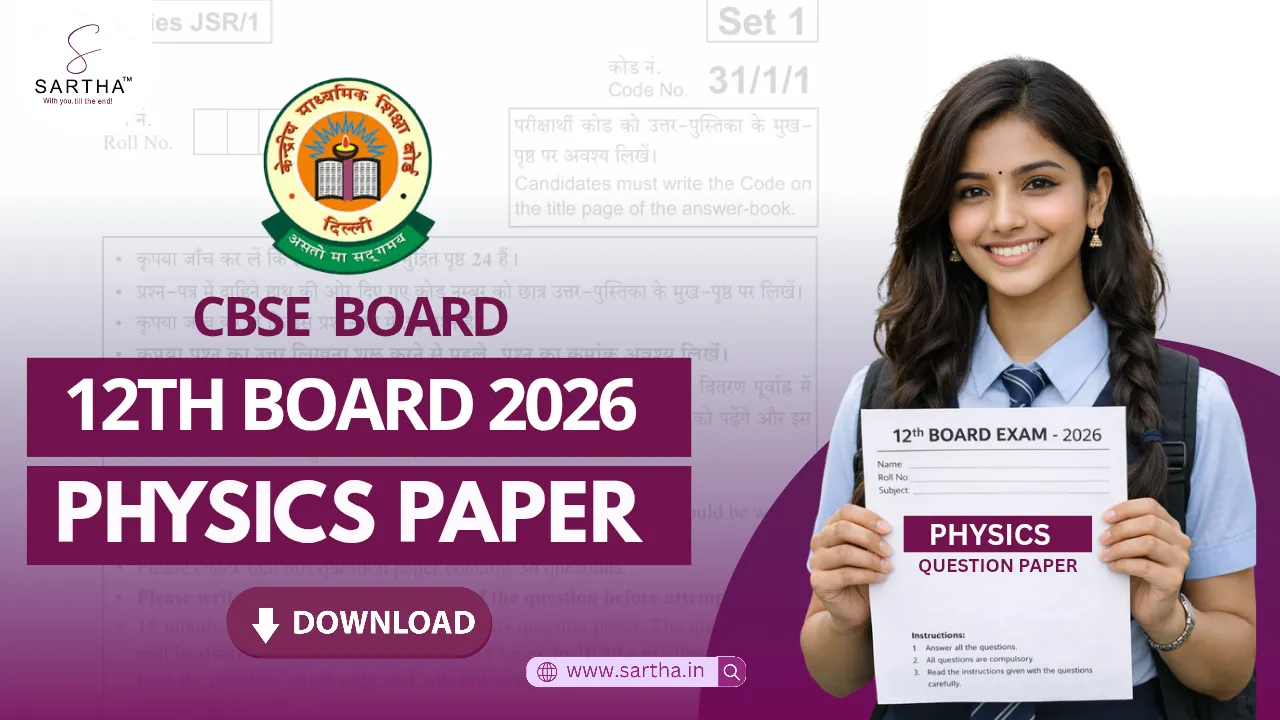
CBSE Board Class 12 Physics Question Paper 2026 PDF Available Download Now:Download Paper,Answer Key Solutions, Paper Analysis

Download CBSE board Class 12 Physics Question Paper 2026,2025 PDF (Code 042): access the CBSE 12th Physics board paper, answer key, paper analysis, marking scheme, section-wise exam pattern, difficulty level and important chapters. Practise the 2025 previous year paper with numericals, derivations, case-study and diagram-based questions from Electrostatics, Current Electricity, Optics, EMI and Modern Physics to understand the expected CBSE Physics 2026 pattern and improve board exam preparation.
Download CBSE Class 12 Physics Question Paper 2026 PDF (Code 042)
Get the official Class 12 Physics board paper, answer key, paper analysis, marking scheme, section-wise pattern, difficulty level and important chapters. Also access 2025 previous year paper, numericals, derivations and diagram questions to understand the expected CBSE Physics 2026 exam pattern and smart preparation strategy.
CBSE 12th Physics Question Paper PDF Download 2026
The CBSE board Class 12 Physics examination for 2026 is now over on 20 February 2026 (10:30 AM to 1:30 PM). The official question paper PDF is now uploaded here. Download CBSE 12th Physics Paper 2026 PDF.
| Paper | Status |
| CBSE Class 12 Physics Question Paper 2026 PDF | Available Download Now |
Once released, the direct PDF download link will be updated here so you can analyse the real 2026 board paper and compare it with the 2025 pattern.
Join Channels For PDF & Updates
Get 2026 Board Exam PDFs, Important Questions, and News Updates for Class 12th.
 JOIN WHATSAPP CHANNEL
 JOIN TELEGRAM CHANNEL
CBSE 12th Physics Question Paper 2025 – Direct PDF Download
Students preparing for the CBSE board Class 12 Physics exam should first practise the latest real paper. The 2025 board paper is the most important one because CBSE usually repeats question patterns, numericals, derivations and diagram-based questions from the immediate previous year.
| Important Download | Link |
| CBSE Class 12 Physics Paper 2025 PDF – Download Now | Click here to download |
Try to solve this paper in proper exam conditions. Students who practise real board papers usually score higher because they become familiar with the type of numericals, derivations and theory questions asked by CBSE.
CBSE 12th Physics 2025 Paper Pattern Analysis
The CBSE board Class 12 Physics 2025 paper followed the expected blueprint. The overall difficulty level was moderate to difficult (some sets were trickier). Most questions were directly based on NCERT textbook concepts, previous year patterns and the latest sample paper.
| Section | Type of Questions | Approx Marks | Difficulty Level |
| Section A | MCQs + Assertion-Reasoning (1 mark) | 16 Marks | Moderate (some tricky) |
| Section B | Very Short Answer (2 marks) | 10 Marks | Moderate |
| Section C | Short Answer (3 marks) | 21 Marks | Moderate |
| Section D | Case Study-based (4 marks) | 8 Marks | Moderate |
| Section E | Long Answer (5 marks) | 15 Marks | Moderate to Difficult |
2026 Board Papers PDF
Download Papers PDF , Important Questions & Get Updates for 2026 Board Exams.
Students noticed repeated concepts from chapters like Electrostatics, Current Electricity, Optics, Electromagnetic Induction and Modern Physics. This clearly shows that solving previous papers is one of the most effective preparation methods.
Difficulty Level of CBSE Physics 2026 Paper
Based on recent CBSE trends and the 2025 paper pattern, the 2026 Physics paper is remained moderate and NCERT-based. The board repeated the same pattern with slight changes in numerical values and case studies instead of introducing completely new formats.
| Topic Area | Expected Weightage | Preparation Focus |
| Electrostatics & Capacitance | High (16 marks) | Numericals, derivations, field lines |
| Current Electricity | High (10–12 marks) | Numericals, Kirchhoff’s laws, Wheatstone bridge |
| Magnetic Effects, EMI & AC | High (14–16 marks) | Derivations, graphs, LCR circuits |
| Optics (Ray + Wave) | Very High (14 marks) | Ray diagrams, lens/mirror formula, interference |
| Modern Physics | Medium (12–14 marks) | Theory, energy levels, logic gates |
If you focus on NCERT examples, all derivations, important numericals and 5–6 previous year papers, scoring above 60 out of 70 in Physics becomes very realistic. CBSE rarely asks out-of-syllabus questions, so smart revision matters more than studying new material at the last moment.