CBSE Class 12 Chemistry 2026 Day 2: Chemical Kinetics Important Questions, Half-Life Numericals & Arrhenius Equation

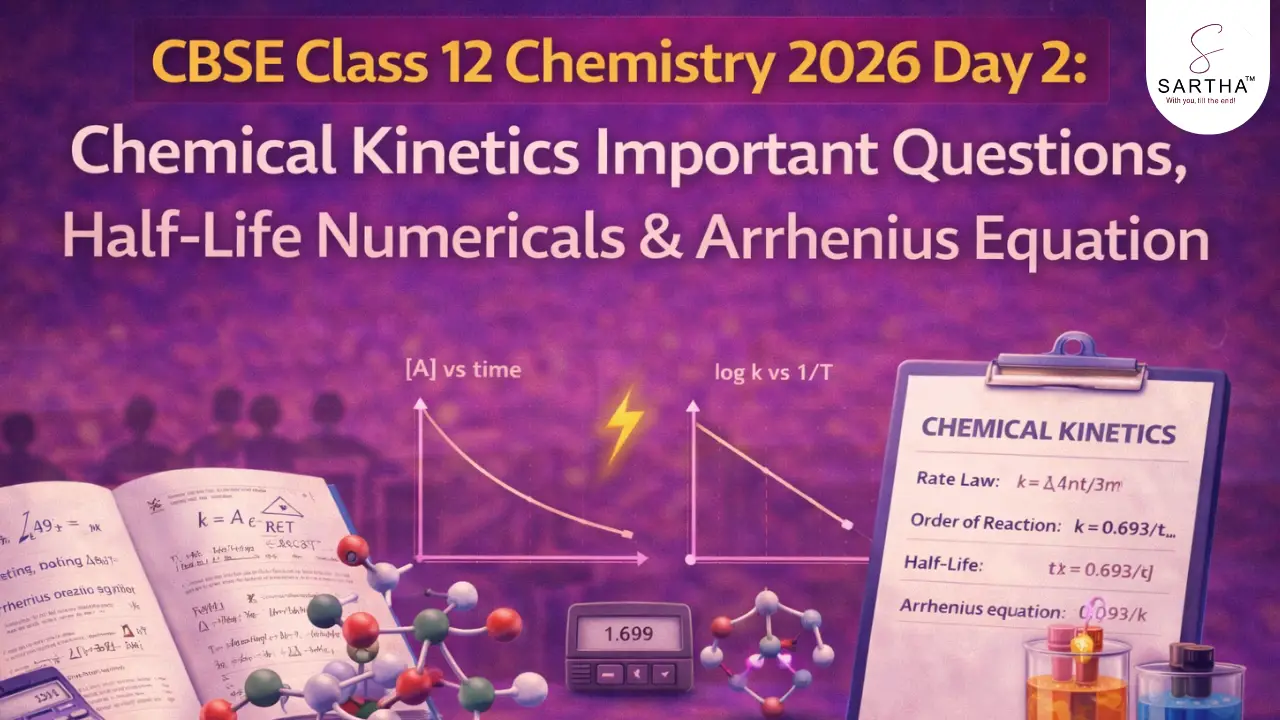
CBSE Class 12 Chemistry 2026 Day 2 revision plan: Chemical Kinetics important questions, rate law and order of reaction, half-life numericals, rate constant calculations and Arrhenius equation concepts for the 28 February board exam. Includes activation energy, pseudo-first order reaction, integrated rate equations, graphs (ln[A] vs time, log k vs 1/T), common mistakes and quick problem-solving strategy to score high in Physical Chemistry.
Day 2 Master Plan: Chemical Kinetics – Rate Laws, Half-Life Numericals, Arrhenius Equation & 30+ Important Questions for CBSE Class 12 Chemistry 2026
Welcome to Day 2 revision (23 February 2026). Your CBSE Class 12 Chemistry exam is now very close — only a few days remain before 28 February 2026. Today’s target chapter is Chemical Kinetics, a highly scoring unit worth nearly 7 marks. This chapter is predictable every single year because CBSE repeats the same types of questions: half-life calculations, rate constant numericals, Arrhenius equation and graphs.
Join Channels For PDF & Updates
Get 2026 Board Exam PDFs, Important Questions, and News Updates for Class 12th.
 JOIN WHATSAPP CHANNEL
 JOIN TELEGRAM CHANNEL
Students often fear Physical Chemistry, but this chapter is actually the fastest to solve in the exam. If formulas are clear, you can complete kinetics questions within 10–12 minutes and secure almost full marks. Focus on understanding graphs, remembering formulas and practising 4–5 numericals — that is enough to master the chapter.
Expected Weightage & Question Types
| Area | Marks | What CBSE Asks |
| Rate law & order | 2 | Definition, rate expression, units |
| Half-life numericals | 2–3 | First order reaction calculations |
| Arrhenius equation | 2 | Activation energy and temperature effect |
| Graphs & theory | 1–2 | Plots and conceptual MCQs |
Quick Revision Notes
- 1. Rate of reaction: change in concentration per unit time
- 2. Rate = − d[A]/dt (reactant) and + d[P]/dt (product)
- 3. Rate law: Rate = k[A]m[B]n
- 4. Order: m + n (experimentally determined)
- 5. Molecularity: number of molecules in elementary step (always whole number)
6. Integrated Rate Equations:
- Zero order → [A] = [A]₀ − kt
- First order → ln[A] = ln[A]₀ − kt
- Second order → 1/[A] = 1/[A]₀ + kt
- 2026 Board Updates
2026 Board Papers PDF
Download Papers PDF , Important Questions & Get Updates for 2026 Board Exams.
Half-Life Formulas (Very Important)
| Order | Half-life Formula | Key Point |
| Zero order | t½ = [A]₀ / 2k | Depends on initial concentration |
| First order | t½ = 0.693 / k | Independent of concentration |
| Second order | t½ = 1 / (k[A]₀) | Inversely proportional |
Arrhenius Equation (Most Asked)
1. k = A e−Ea/RT
2. At 298 K (log form): log k = log A − Ea/(2.303 RT)
- 3. A = frequency factor
- 4. Ea = activation energy
- 5. Higher Ea → slower reaction
- 6. Catalyst lowers Ea
Important Graphs Must Remember
- 1. [A] vs time → straight line (zero order)
- 2. ln[A] vs time → straight line (first order)
- 3. 1/[A] vs time → straight line (second order)
- 4. log k vs 1/T → Arrhenius plot
High-Probability 1-Mark Questions
- 1. Define rate constant.
- 2. What is order of reaction?
- 3. What is molecularity?
- 4. Define activation energy.
- 5. What is pseudo-first order reaction?
- 6. Unit of first-order rate constant (s⁻¹).
- 7. Effect of catalyst on reaction rate.
Important 2–3 Mark Questions
- 1. Difference between order and molecularity
- 2. Explain pseudo-first-order reaction
- 3. Derive first-order integrated rate equation
- 4. Explain temperature effect on rate
- 5. Explain collision theory
- 6. Explain catalyst action
Most Important Numericals
- 1. Calculate half-life of first order reaction
- 2. Find order from rate data
- 3. Calculate rate constant k
- 4. Activation energy from two temperatures
- 5. Time required for concentration change
MCQ Practice (Very Important)
- 1. First-order half-life independent of concentration
- 2. Catalyst does not change ΔH
- 3. Pseudo-first-order example: ester hydrolysis
- 4. Higher temperature increases rate
- 5. Activation energy unit: kJ mol⁻¹
- 6. Order may be zero or fractional
- 7. Molecularity never fractional
- 8. Most reactions are complex reactions
Common Mistakes Students Make
- 1. Confusing order with molecularity
- 2. Using wrong units for k
- 3. Not converting minutes to seconds
- 4. Forgetting log vs ln formula
- 5. Wrong slope in Arrhenius graph