CBSE 12th Board 2026 Chemistry Final Revision: Organic Chemistry (33 Marks) Name Reactions, Functional Tests & Biomolecules

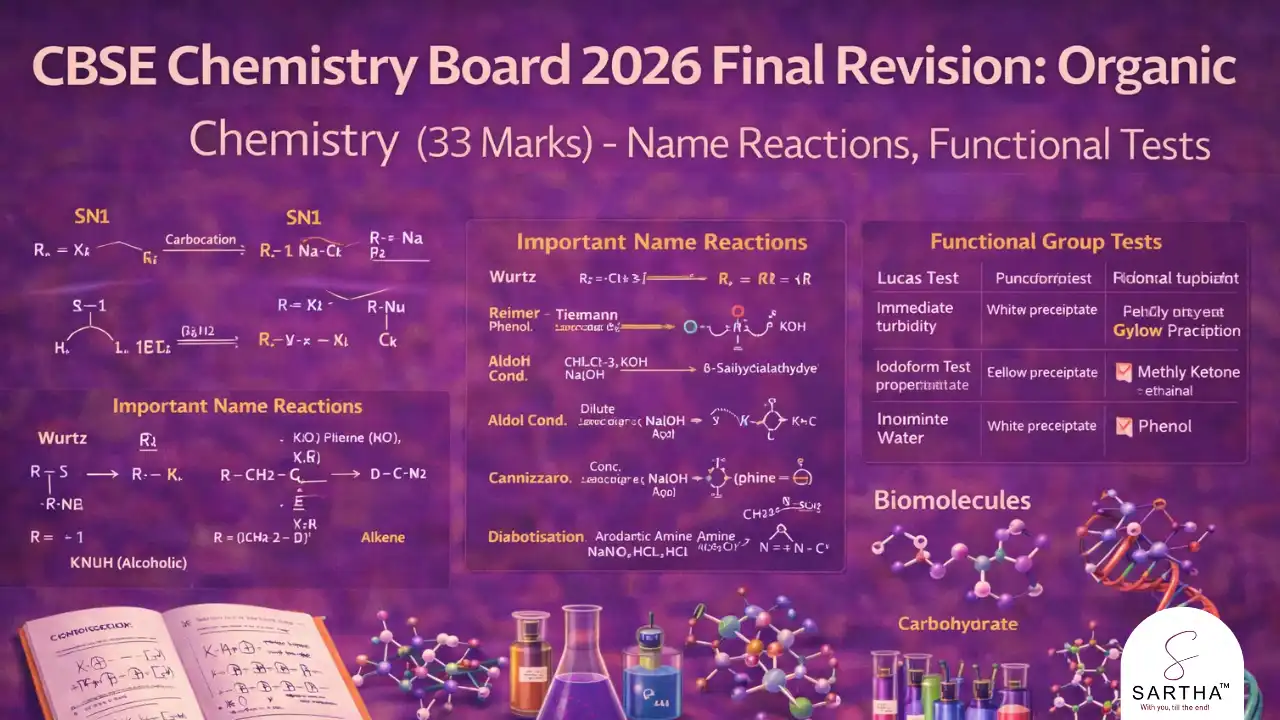
Haloalkanes to Biomolecules complete Organic Chemistry revision for CBSE Class 12 Chemistry Board Exam 2026: revise SN1 and SN2 mechanisms, elimination reactions, haloarenes reactivity, phenol acidity, Williamson ether synthesis, functional group tests (Lucas test, iodoform test, bromine water), name reactions (Wurtz, Sandmeyer, Reimer–Tiemann, Kolbe), carbonyl reactions (Aldol, Cannizzaro, Clemmensen, Wolff–Kishner, HVZ), amines reactions (carbylamine, diazotisation, Hofmann bromamide, Gabriel synthesis), acidity order, conversions and reagents, plus Biomolecules concepts including carbohydrates, proteins, peptide bond and DNA–RNA structure for last-minute smart revision and high-scoring preparation.
Haloalkanes to Biomolecules – Complete Revision for CBSE Class 12 Chemistry Board Exam 2026
The CBSE Class 12 Chemistry board exam is scheduled on 28 February 2026 and now only 1–2 days remain. This single post covers the entire Organic Chemistry portion (approx. 33 marks), which alone can decide whether your final score crosses 90%.
Organic Chemistry is not about memorising paragraphs — it is about understanding mechanisms, reagents, name reactions and functional group tests. Most toppers score high because they revise reactions properly, not because they read theory again and again.
Recent CBSE trends show:
- 1. Mechanisms & name reactions → 8–10 marks
- 2. Conversions & reagents → 5–6 marks
- 3. Biomolecules → 4–5 marks
- 4. MCQs from functional group tests → 5+ marks
If you master the sections below, nearly half of the Chemistry paper becomes predictable.
Join Channels For PDF & Updates
Get 2026 Board Exam PDFs, Important Questions, and News Updates for Class 12th.
 JOIN WHATSAPP CHANNEL
 JOIN TELEGRAM CHANNEL
Part 1: Haloalkanes, Haloarenes, Alcohols, Phenols & Ethers
Core Concepts You Must Remember
- SN1 reaction: Carbocation intermediate, racemisation, stability 3° > 2° > 1°
- SN2 reaction: One-step mechanism, backside attack, inversion of configuration
- Elimination (E1/E2): Alcoholic KOH gives alkene
- Haloarenes: Less reactive due to resonance
- Phenol acidity: Greater than alcohol because phenoxide ion is resonance stabilised
- Ether preparation: Williamson synthesis
Important Functional Tests
| Test | Observation | Compound Identified |
| Lucas Test | Immediate turbidity | Tertiary alcohol |
| Iodoform Test | Yellow precipitate | Methyl ketone / ethanol |
| Bromine Water | White precipitate | Phenol |
Very Important Reactions
- 1. Wurtz reaction → Alkane formation
- 2. Sandmeyer reaction → Haloarene formation
- 3. Reimer-Tiemann → Phenol → Salicylaldehyde
- 4. Kolbe reaction → Phenol → Salicylic acid
- 5. Ether cleavage → HI gives alcohol + alkyl iodide
Part 2: Aldehydes, Ketones & Carboxylic Acids
Most Important Name Reactions
| Reaction | Reagent | Product |
| Aldol Condensation | Dilute NaOH | β-hydroxy aldehyde |
| Cannizzaro | Conc. NaOH | Alcohol + Acid |
| Clemmensen Reduction | Zn-Hg/HCl | Carbonyl → Alkane |
| Wolff-Kishner | NH₂NH₂/KOH | Carbonyl → Alkane |
| HVZ Reaction | Cl₂/Br₂ + Red P | α-halo acid |
Important: Cannizzaro reaction occurs only when aldehyde has no alpha hydrogen.
2026 Board Papers PDF
Download Papers PDF , Important Questions & Get Updates for 2026 Board Exams.
Amines
- 1. Basicity order (aqueous): 2° > 1° > 3° > NH₃
- 2. Carbylamine test → foul smell confirms primary amine
- 3.Diazotization → Aromatic amine + NaNO₂/HCl (0–5°C)
- 4. Hofmann bromamide → Amide → Amine (one carbon less)
- 5. Gabriel synthesis → Pure primary amine preparation
Biomolecules
Carbohydrates
- 1. Glucose is an aldohexose
- 2. Sucrose is non-reducing sugar
- 3. Starch & glycogen → storage polysaccharides
Proteins
- 1. Peptide bond = –CO–NH– linkage
- 2. Denaturation destroys secondary & tertiary structure
- 3. Enzymes are protein catalysts
Nucleic Acids
- 1. DNA double helix structure
- 2. A pairs with T, G pairs with C
- 3. RNA contains uracil instead of thymine
Important Acidity Order
Carboxylic acid > Phenol > Water > Alcohol
Exam Strategy
- 1. Revise all name reactions once
- 2. Memorise functional group tests
- 3. Practice 5 conversions
- 4. Revise biomolecules diagrams
- 5. Do not start new topics