NEET 2026: NTA’s Viral Tweet Exposes the Real Difficulty Level of the Exam

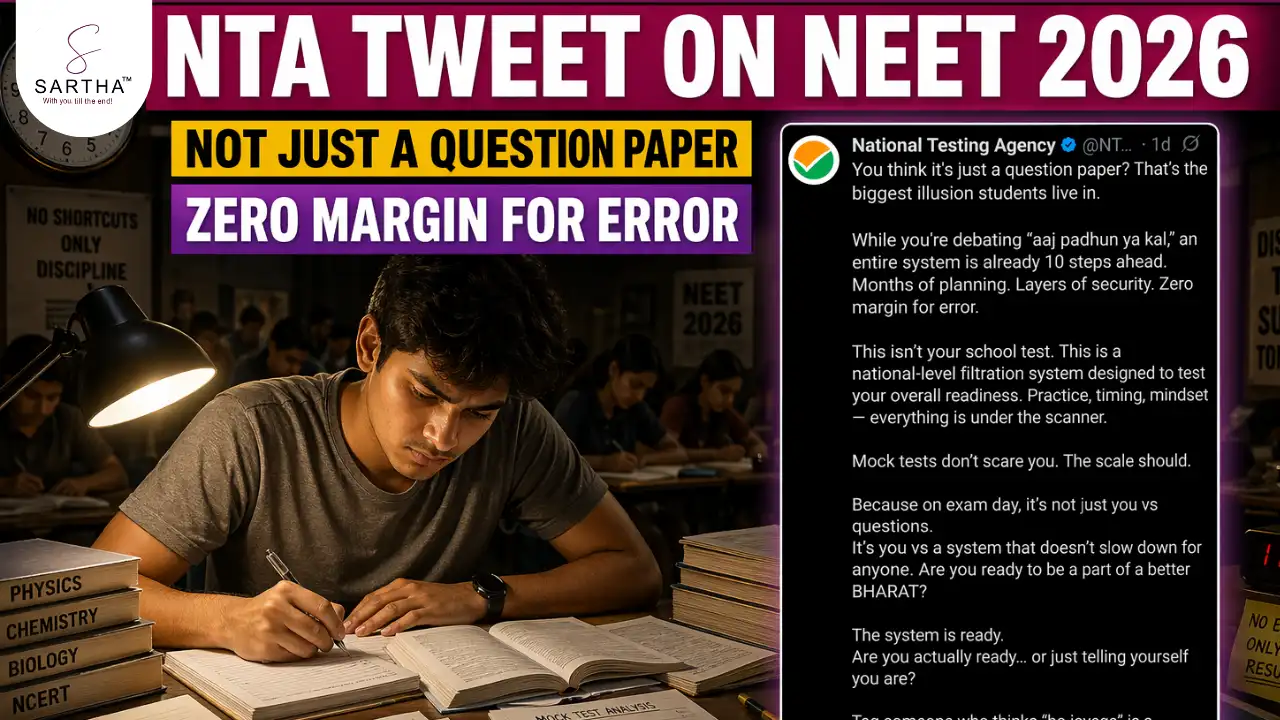
The latest tweet by the National Testing Agency (NTA) has sparked serious discussion among NEET 2026 aspirants, delivering a sharp reality check about the nature of national-level exams. The message is clear—this is not just another question paper, but a highly structured filtration system where preparation gaps are exposed instantly.
With NEET 2026 approaching, this statement highlights the growing concern over student mindset, consistency, and readiness. The agency indirectly points out that casual preparation, delays, and overconfidence may not survive the pressure of such a competitive system.
What NTA Is Trying to Convey
The tweet emphasizes that NEET is not just about solving questions but about competing within a system that is already optimized, controlled, and unforgiving. Every aspect—from paper design to execution—is planned months in advance with strict protocols.
This means students are not only being tested on knowledge but also on:
- Consistency of preparation
- Time management under pressure
- Mental stability during the exam
- Accuracy with speed
The phrase “zero margin for error” reflects how even small mistakes can significantly impact ranks in an exam like NEET.
Why This Tweet Matters
This is more than a motivational post—it is a warning. Many students still rely on the mindset of “kal se padhunga” or “ho jayega,” which directly conflicts with the level of discipline required for NEET.
The tweet underlines that the competition is not static. While a student delays preparation, thousands of others are improving daily. The “system” keeps moving forward, but the student may stay stuck.
In simple terms, the gap between preparation and expectation becomes the biggest risk.
NEET WhatsApp Updates
Join SARTHA™ for NTA Notices, State Counseling alerts, and Seat Matrix updates for NEET 2026.
 Join SARTHA™ WhatsApp Channel
Key Difficulty Factors Highlighted
The NTA message indirectly reveals the real difficulty level of NEET beyond just syllabus:
1. Scale of Competition
Lakhs of students appear, but only a small percentage secure top medical seats. It’s not about passing—it’s about ranking.
2. Pressure Environment
Unlike school exams, NEET has strict timing, surveillance, and no flexibility. One panic moment can affect performance.
3. Multi-Layered Testing
Concepts, speed, accuracy, and endurance are tested together—not separately.
4. System Discipline
The exam process is rigid. There is no adjustment for late realization or incomplete preparation.
Mock Tests vs Real Exam Reality
The tweet clearly states: “Mock tests don't scare you. The scale should.”
This highlights a common mistake—students perform well in coaching tests but fail to replicate the same in the actual exam.
The difference lies in:
- Real exam pressure
- Higher competition level
- Strict timing enforcement
- No second chances
Mock tests are practice, but NEET is execution. Many students underestimate this transition.
What Students Should Do Now
- Stop delaying preparation – daily consistency is critical
- Treat mock tests seriously – simulate real exam conditions
- Focus on weak areas – not just strong subjects
- Build exam temperament – handle pressure and time limits
- Avoid overconfidence – realistic self-assessment is key
NEET is a system-driven exam, not a casual test. It rewards discipline, preparation, and execution, not assumptions or last-minute effort.
Students must understand that the system will not slow down, adjust, or wait. The only variable is the candidate’s readiness.
If preparation is real, results will follow. If it’s just “ho jayega,” the system will expose it.