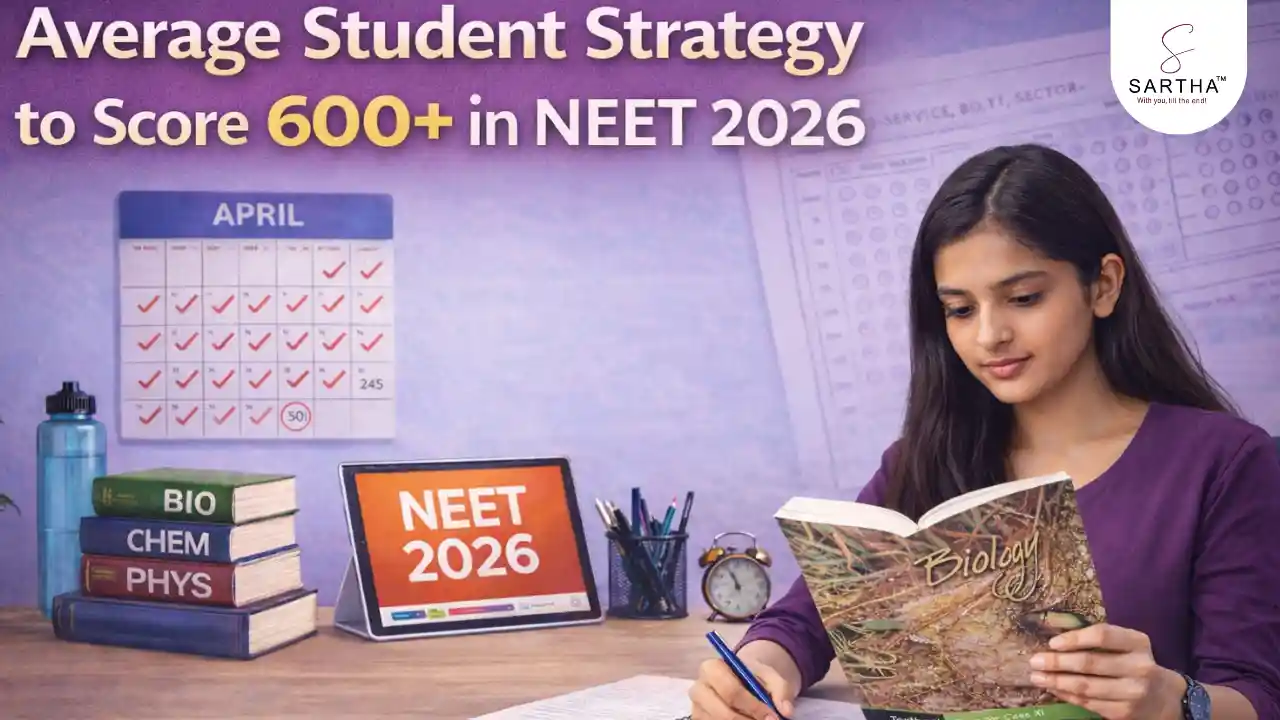
Average Student Strategy to Score 600+ in NEET 2026 (Realistic & Proven Plan)

Average student strategy to score 600+ in NEET 2026 with a realistic NCERT-based study plan. Covers NEET UG 2026 exam pattern, 4-month preparation timetable, subject-wise strategy for Biology, Chemistry and Physics, high-weightage chapters, mock test plan, revision strategy and accuracy tips to help average students crack NEET 2026 and secure a medical seat.
If you consider yourself an average student and are targeting 600+ marks in NEET 2026, this strategy is designed exactly for you. With NEET UG 2026 expected around May 3, 2026 (as per consistent NTA trends), you still have roughly 116–120 effective days. This is a practical, proven, and realistic plan—no hype, no unrealistic 16-hour schedules.
A 600+ score does not require genius-level intelligence. It requires NCERT-focused study, accuracy-based attempts, and consistent revision + mock analysis. The syllabus remains unchanged and NCERT-based as notified by NMC, making this target achievable for disciplined aspirants.
Why 600+ Is Achievable for an Average Student
| Subject | Target Score | Why It’s Realistic |
| Biology | 330+ | Direct NCERT questions, theory-based, high retention |
| Chemistry | 150+ | Inorganic & Organic are predictable, Physical needs practice |
| Physics | 130+ | Formula-based questions from high-weightage chapters |
| Total | 610–630 | Comfortably crosses 600 with controlled negatives |
Daily Study Time for Average Students
An 8–10 hour daily routine is sufficient if followed consistently. Burnout is avoided, and retention improves.
| Activity | Daily Time |
| Biology (NCERT + MCQs) | 3.5 – 4 Hours |
| Physics / Chemistry (Alternate) | 2.5 – 3 Hours |
| MCQs + PYQs | 2 – 2.5 Hours |
| Revision & Error Log | 1 Hour |
4-Month Realistic Roadmap for NEET 2026
| Month | Main Focus | Key Targets | Mock Frequency |
| January | Syllabus Coverage | 100% NCERT first read, basics clear | 1–2 / week |
| February | Practice & Application | PYQs, chapter tests, numericals | 3 / week |
| March | Revision Cycles | 2–3 revisions, weak-area fixing | 4–5 / week |
| April | Exam Simulation | Daily mocks, accuracy & stamina | Daily |
Subject-Wise Strategy for Average Students (NEET 2026 – 600+ Target)
For an average NEET aspirant, scoring 600+ in NEET 2026 is less about doing everything and more about doing the right things repeatedly. Since the NMC-notified syllabus remains strictly NCERT-based, your success depends on focusing on high-weightage chapters (70–80% questions), building accuracy, and practising daily without burnout.
Biology – The Scoring Backbone (Target: 330–340 / 360)
Biology is the biggest advantage for average students. With 90 questions and over 95% direct NCERT linkage, this subject alone can carry you close to the 600 mark if handled properly.
| Aspect | Strategy for Average Students |
| Core Approach | NCERT line-by-line reading (6–8 revisions) |
| Daily Practice | 1–2 chapters revision + ~100 MCQs |
| High-Weightage Areas | Human Physiology, Genetics & Evolution, Ecology, Reproduction, Biotechnology |
| Question Types | Diagram-based, Assertion-Reason, NCERT statement twists |
| Common Mistake | Ignoring diagrams & NCERT examples |
| Expected Outcome | 85–90 correct answers → 330+ marks |
Connect with SARTHA™
Join Free our Telegram & WhatsApp Channel for Exam, Counseling , Cutoff related Updates & Notifications
Chemistry – (Target: 150–160 / 180)
Chemistry rewards consistency. Questions are direct, repeated in pattern, and well-distributed across sections—making it ideal for average students who revise regularly.
| Section | Focus Strategy | High-Yield Chapters |
| Inorganic | Pure NCERT memorisation, exceptions | Chemical Bonding, Coordination, p-Block |
| Organic | GOC + reaction mechanisms | Aldehydes & Ketones, Hydrocarbons, Biomolecules |
| Physical | Daily 20–30 numericals | Thermodynamics, Equilibrium, Kinetics |
| Safe Target | 38–40 correct answers with minimal negatives | |
Physics – (Target: 130–140 / 180)
Physics feels tough for many average students, but NEET Physics is formula-based and repetitive. Mastering high-weightage chapters is enough to score safely.
| Focus Area | What to Do |
| Daily Routine | Revise formula sheet + solve 40–60 numericals |
| High-Weightage Chapters | Mechanics, Electrostatics, Current Electricity, Optics, Modern Physics |
| Key Skills | Units, graphs, dimensional analysis |
| What to Avoid | Blind guessing numericals |
| Expected Score | 30–35 correct answers → 120–140 marks |
Golden Rules That Push Scores Beyond 600
| Rule | Why It Matters |
| Accuracy > Attempts | 160–170 safe attempts beat risky guessing |
| Error Notebook | Reduces repeated mistakes by 40–50% |
| Same-Day Mock Analysis | Immediate correction improves retention |
| Exam Order | Biology → Chemistry → Physics gives confidence & control |
| Sleep & Health | Burnout directly lowers accuracy and recall |
If followed consistently, this subject-wise strategy allows an average student to improve 40–50 marks per month and comfortably cross the 600+ NEET 2026 threshold. The key is steady execution—not extraordinary talent.
Start today with one NCERT Biology chapter. Small daily wins compound into a medical seat.